Polyphonic ear training · iOS
You hear the melody.
Can you hear the alto?
Every ear trainer on the store teaches you to listen vertically — name the interval, name the chord, echo the tune. Not one of them teaches the thing choral singers, organists and composers actually need: following one voice while three others try to talk you out of it. That is the only thing Voces does, and it does it with Bach, who is responsible for the problem in the first place.
Free to try · no account · works offline · nothing leaves your device

He walked four hundred kilometres to hear one organist.
Three excerpts. Which voice entered?
In each one, the voices start at different moments. Say which one came in last. Every voice uses the same instrument and sits dead centre in the stereo field — no timbre hints, no left-and-right. Only the line itself tells you where it is.
Headphones or decent speakers help. Takes about a minute.
1 of 3
Which voice entered last?
Now you can see where each one came in. Hear it alone, then in the texture again — that is the motion the app trains: finding the line without stripping it out.
This browser will not give us audio. Try Safari or Chrome with sound on.
That is still the easy version — you are only asked to name the voice. The app asks harder questions: sing the voice while the others keep playing, and follow it once it stops being the one that just moved.
The whole category listens in one direction
Intervals, chords, single melodies — that is vertical hearing, and it is well served. Horizontal hearing, the ability to hold one line while others cross it, is not trained by anybody. It is also the skill that decides whether you can hold your part in a choir, read a fugue, or voice-lead without a piano.
| App | Intervals & chords | Single melody | One voice inside many |
|---|---|---|---|
| EarMaster | Yes | Yes | No |
| Tenuto | Yes | No | No |
| Perfect Ear | Yes | Yes | No |
| ToneGym | Yes | Yes | No |
| Voces | — | Yes | The entire app |
Voces is not a replacement for an interval trainer. It is the exercise you move on to once naming intervals stopped being the hard part.
Four ways in, hardest last
01
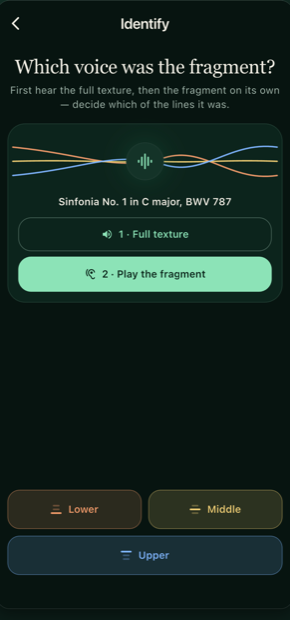
Identify
A texture plays and one voice does something — enters, moves, takes the subject. Name it. No singing, no notation, nothing to set up. This is where most people discover they have been hearing the top line and calling it the music.
02
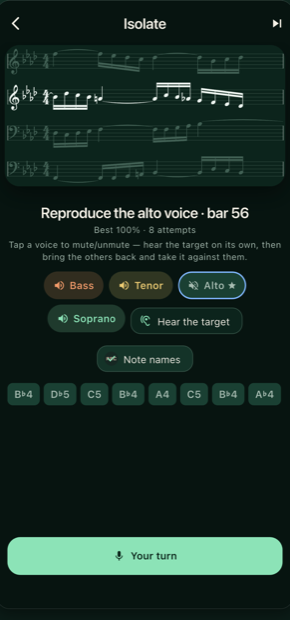
Isolate
The score is on screen, your voice is highlighted, the others are greyed. All of them play. You sing it — or hum, whistle, or play it on an instrument. Mute and solo any voice beforehand to study it, then bring them all back and hold your line against them.
03
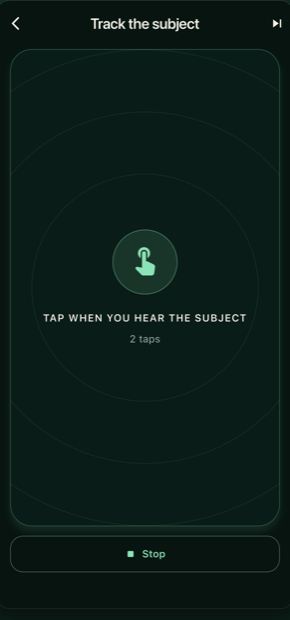
Track
A fugue subject moves between voices. Tap every time it enters. This is the exercise that turns a fugue from a wash of counterpoint into an architecture you can hear the shape of.
04
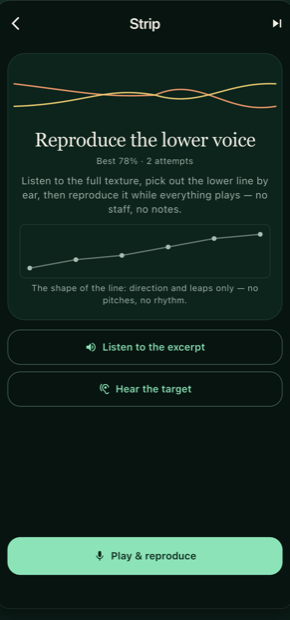
Strip
Same as Isolate, with everything taken away. No score, no highlight, no name on the screen. You are told which voice and you sing it. If you can do this on a four-voice chorale, you can hold your part anywhere.
The part nobody else does
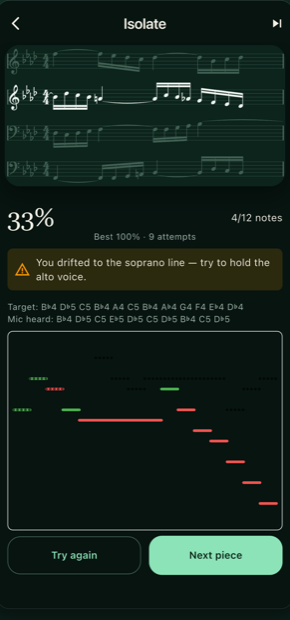
“You drifted to the upper line.”
Anything can tell you whether you sang in tune. The hard question is whether you sang the right line — and the honest failure mode is not being flat, it is drifting onto the voice that pulls hardest.
So Voces scores your sung contour against the voice you were asked for, and then against every other voice in the piece. Dynamic time warping, so losing the tempo does not cost you. Octave-tolerant, so singing it an octave down is fine. And if your line matches the soprano better than the tenor you were given, it says so, by name.
That single sentence is the product. Without it you can practise for a month, feel accurate, and be training the exact habit you came to break.
- Per-note scoring against the target contour, ±50 cents.
- Drift detection naming the voice you actually sang.
- Contour overlay — your line drawn over the one you were given.
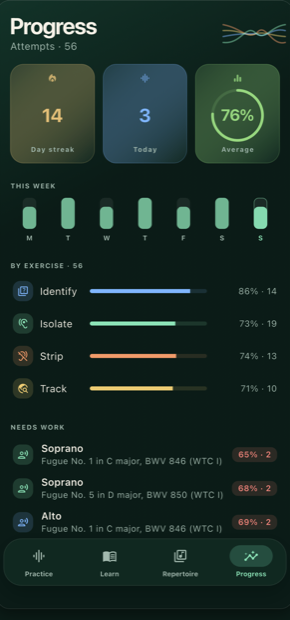
- Per-voice history, because everyone has one voice that is worse.
It knows why a line is hard
Difficulty here is not a slider from one to three. Every bar of every voice in the corpus is scored on eight musical properties: how closely the neighbouring voices run, note density, the size of the leaps, the span the line covers, whether it is an inner voice, whether voices cross, how many voices there are, and how much the other parts are doing while yours moves.
The result is a progression that gives you the bar that is hard for the reason you are currently weak on — and demotes as readily as it promotes. Twenty-two tags across five categories mean you can also just go and drill tritone leaps in an inner voice, if that is the thing.
Real music, not exercise material
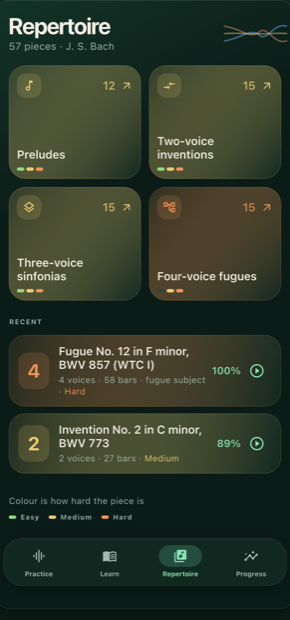
Fifty-seven pieces, all Bach, because nothing else writes independent voices with that clarity. Nothing here was generated. You are learning to hear the alto in music that has an alto worth hearing.
Scores are typeset from the Bach-Gesellschaft edition and are in the public domain — the licence of every bundled piece is listed in the app, by piece. Voices arrive already separated by the engraver, not reconstructed by guessing at pitch, which is why the middle voice of a sinfonia is actually the middle voice.
Not only drills
The theory, wired to the sound
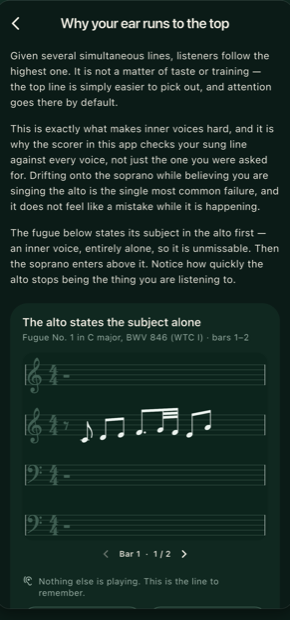
Seven topics on how polyphony actually works — what a subject is and why it is recognisable, why an inner voice hides, how suspensions pull the ear away from the line you are holding. Every claim is attached to a real bar of the real corpus, and every example plays.
Reading about voice leading and hearing it are different activities. These are the same screen.
Who this is for
Choral singers
You can hold the alto with the section. Alone, against three other parts, is a different skill — and it is the one rehearsal never has time for.
Choirmasters & organists
Hearing which part went wrong, while it is going wrong, from the middle of the texture.
Theory students
Solfège classes assess this and rarely train it. Here it is, drillable, ten minutes a day.
Composers & arrangers
Voice leading you can hear instead of check. The inner voices stop being arithmetic.
Serious listeners
You have listened to the Art of Fugue forty times. This is how you start hearing the third entry.
Not for
Absolute beginners. If naming a major third is still work, start with an interval trainer and come back.
Your microphone stays on your phone
Voces has no backend. Pitch detection and scoring run on the device, the whole corpus ships inside the app, and there is no account to make. Your singing is analysed as it happens and is never recorded, stored or uploaded — there is nowhere for it to go. Put the phone in airplane mode and everything still works.
The only network call the app ever makes is about a purchase — to Apple, and to RevenueCat, which checks whether you have paid. Nothing about your practice leaves the device. Full privacy policy.
Pricing
Free covers five pieces across all four exercise types, with no time limit and no daily cap — enough to find out whether you can do this at all. Launch pricing below; it goes up once there are reviews, and anyone who subscribes before then keeps their rate.
Free
$0
- 5 pieces
- All four exercise types
- Unlimited attempts, no daily cap
- The whole scorer, drift warning included
- All seven Learn topics
- Week one of the course
Best value
Annual
$29.99/year
- 7-day free trial
- All 57 pieces and everything added later
- The full eight-week course, 40 lessons
- Any piece learned section by section
- Adaptive progression, per-voice stats
- Per-voice solo and mute
Monthly
$5.99/month
- Everything in Annual
- Cancel any time
Lifetime
$69.99once
- Everything, permanently
- Future content packs included
Prices in USD and adjusted for your region. Subscriptions renew automatically until cancelled; manage or cancel in your App Store account. Terms · Privacy
Teaching a class or a choir? Twenty seats or more come at half price — write to us.
Questions
Do I need perfect pitch?
No, and it barely helps. This is about attention, not absolute reference. Relative pitch good enough to sing back a phrase is the entry requirement.
I can't really sing.
You do not need to. Humming on a single vowel is what the pitch detector likes best, and whistling or playing works just as well. Octave transposition is forgiven too — over the bundled corpus only about a third to a half of exercises sit inside a normal voice's range as written, so taking a line an octave away is expected rather than penalised.
One catch, and it is deliberate: the octave is forgiven once, for the whole line. Right notes in wandering octaves is not a transposition, it is a line that was not held, and it does not score.
Do I have to read music?
For Identify and Track, no. Isolate shows notation but highlights your voice, and plenty of people use it to start reading. Strip removes notation entirely.
Can I play the line on an instrument instead?
Yes, two ways. Play it acoustically into the microphone — the detector measures frequency, not timbre, so a violin, a recorder, a guitar or a whistle are the same case as a voice and need no setting changed. Or connect a MIDI instrument, in which case the note numbers arrive exactly, nothing is estimated at all, and the microphone is never opened.
What MIDI gear works?
Anything iOS can see: a keyboard over USB, a Bluetooth LE controller, or network MIDI. There is no port to pick — the app connects to every source the system offers, so an instrument works the moment it is plugged in or paired. Bluetooth pairing goes through the standard iOS sheet, and Settings has a MIDI check screen that shows what is connected and what it is sending.
Does it work offline?
Entirely. Corpus, playback, pitch detection and scoring are all on the device.
Android?
After iOS. The codebase is shared, so it is a matter of when, not whether.
Why only Bach?
Because independent voices that stay independent are rarer than you would think, and Bach wrote more of them than anyone. Renaissance polyphony and four-part chorales are the next packs.

About the fellow on the icon
He walked four hundred kilometres to listen
Every portrait of Bach is the same one: sixty, severe, holding a canon at you like a summons. But the man was twenty once. He asked his employer for four weeks off, walked the four hundred kilometres to Lübeck to hear one organist play, and came back four months late. He also fathered twenty children and once got into a street argument with a bassoonist. He wrote four independent voices at once and made it sound like pleasure rather than homework.
So ours is young, pink about the cheeks, and has clearly just come a long way to hear something.
Hear the voices
Free to try. Ten minutes a day is the whole method.
Download on the App StoreiPhone and iPad · iOS 13 and later · sing, play, or connect a MIDI instrument